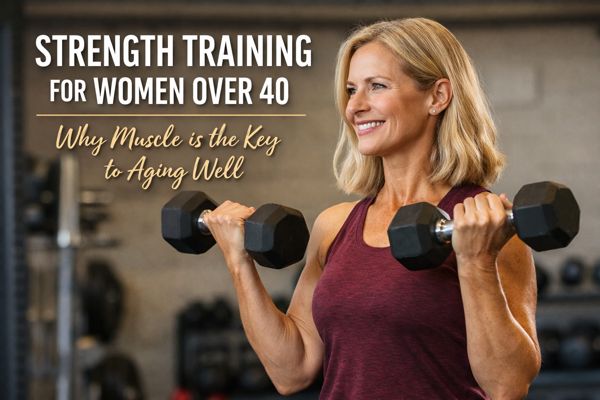
Strength Training for Women Over 40: Why Muscle Is the Key to Aging Well
For decades, women have been told the formula is simple:
Eat less.
Move more.
Do more cardio.
If weight creeps up after 40, the advice gets louder. Cut calories. Add treadmill time. Sweat harder.
But here is the truth.
After 40, the greatest risk to your long-term health is not weight gain.
It is muscle loss.
And no amount of calorie cutting or endless cardio will protect you from that.
Strength is how we age well.
If you want energy in your 50s, stability in your 60s, and independence in your 70s, muscle preservation is not optional. It is foundational.
What Actually Happens to a Woman’s Body After 40
Beginning in our 30s, women lose approximately 3 to 8 percent of muscle mass per decade. This process, known as sarcopenia, accelerates during perimenopause and menopause due to changes in estrogen.
Estrogen plays a role in muscle maintenance, bone density, and metabolic regulation. As levels decline, several shifts occur:
Muscle mass decreases more rapidly
Bone mineral density begins to drop
Insulin sensitivity changes
Recovery capacity declines
Visceral fat becomes easier to store
This is not a motivation issue. It is physiology.
Muscle is metabolically active tissue. It influences resting metabolic rate, glucose control, and fat distribution. When muscle declines, metabolic resilience declines with it.
Many women assume their metabolism has “broken.” In reality, their muscle mass has quietly decreased.
Why Cardio Alone Stops Working After 40
Walking is beneficial. Cardiovascular exercise supports heart health, circulation, and mood.
But cardio alone does not provide enough resistance to preserve muscle mass.
When cardio is paired with calorie restriction, the body often pulls from both fat and lean tissue for energy. Over time, this can reduce muscle mass and lower resting metabolic rate.
The result?
You may burn calories during the workout, but your long-term metabolic protection declines.
Excessive cardio, especially when recovery is inadequate, can also elevate cortisol. Chronically elevated cortisol is associated with increased abdominal fat storage.
The solution is not to eliminate cardio.
The solution is to prioritize strength.
Walking supports your heart.
Strength training protects your future.
The Research-Backed Benefits of Strength Training After 40
Strength training is one of the most studied interventions for healthy aging. The data is consistent.
1. Strength Training Protects Bone Density
As estrogen declines, bone mineral density decreases. Resistance training places mechanical load on bone, stimulating bone remodeling through osteoblast activity.
Multiple studies show that women who engage in regular resistance training maintain higher bone density compared to their sedentary peers.
Fractures later in life are strongly associated with loss of independence. Strength training is preventative care.
2. Muscle Improves Blood Sugar Regulation
Muscle tissue acts as a glucose reservoir. Resistance training improves insulin sensitivity and enhances glucose uptake into muscle cells.
Research in menopausal women consistently shows improvements in metabolic markers when structured resistance training is included.
Better blood sugar regulation means:
More stable energy
Fewer cravings
Reduced visceral fat accumulation
This is how muscle protects metabolic health.
3. Strength Is Associated With Longevity
Large population studies have found that greater muscular strength is associated with lower all-cause mortality.
Strength is not cosmetic tissue. It is protective tissue.
Higher strength levels correlate with better mobility, reduced fall risk, and improved quality of life in later decades.
Strength is how we age well.
4. Cognitive and Mental Health Benefits
Emerging research suggests resistance training supports executive function, memory, and mood regulation in midlife and older adults.
Strength training has been linked to improved brain health markers and reduced symptoms of anxiety and depression.
It supports not just your body, but also your clarity.
What Strength Training Actually Looks Like After 40
You do not need:
Two-hour gym sessions
Daily high-intensity circuits
Extreme calorie restriction
You need consistency and structure.
For most women over 40, research and clinical experience support:
2 to 3 full-body strength sessions per week
Focus on compound movements
Progressive overload
Adequate recovery
Sufficient protein intake
Foundational Movement Patterns
Every week should include:
Squat pattern
Hinge pattern
Push pattern
Pull pattern
Core stability
Balance or loaded carry work
This stimulates muscle, bone, and metabolic adaptation without overwhelming your nervous system.
A Simple Weekly Structure Example
Day 1
Squat variation
Push movement
Row
Core work
Day 2
Hinge variation
Overhead press
Pull movement
Glute bridge or carry
Optional Day 3
Unilateral work
Balance training
Accessory muscle groups
More is not better.
Consistency is better.
The Midlife Shift
Most women over 40 are still trying to shrink.
But the real shift in midlife is this:
We stop training to be smaller.
We start training to be stronger.
We build muscle so we preserve capacity.
We protect bone so we protect mobility.
We improve blood sugar control so we protect metabolic resilience.
Our bodies were designed with remarkable adaptive capacity. When we strengthen them intentionally, we are not chasing vanity. We are stewarding strength so we can continue to serve, lead, and live fully in the decades ahead.
Strength is how we age well.
Frequently Asked Questions About Strength Training for Women Over 40
Is strength training safe for women over 40?
Yes. When programmed correctly with proper form and progressive overload, strength training is not only safe but strongly recommended for women over 40. Research consistently supports resistance training for improving bone density, preserving muscle mass, and reducing injury risk. Consult your healthcare provider if you have specific medical concerns.
How many days a week should women over 40 lift weights?
Most women benefit from 2 to 3 full-body strength sessions per week. This frequency provides enough stimulus to maintain and build muscle while allowing adequate recovery.
Can I lose belly fat with strength training after 40?
Strength training supports fat loss by increasing muscle mass and improving insulin sensitivity. While it does not spot reduce belly fat, it improves overall metabolic function, which helps reduce visceral fat over time.
Is walking enough exercise after 40?
Walking is excellent for cardiovascular health and stress reduction. However, walking alone does not provide sufficient resistance to preserve or build muscle. Strength training should be included alongside walking.
Can women build muscle after menopause?
Yes. Research shows that women can build muscle well into their 50s and beyond with consistent resistance training and adequate protein intake.
Will lifting weights make me bulky?
It is extremely difficult for women to develop large muscle mass without very specific high-volume training and significant caloric surplus. Strength training shapes and strengthens the body. It does not automatically make women bulky.
Ready to Get Started?
If you are ready to move beyond calorie cutting and cardio-only routines, I created a simple starting place.
Download the Strength & Vitality guide, a beginner’s 3-workout guide designed specifically for women over 40 who want to protect their independence and build lasting vitality.
You do not need to overhaul everything.
You need a structure that supports the decades ahead.
Because strength is how we age well.